Do AI Overviews reduce clicks in 2026?

Why it matters
- A 2026 randomized field experiment found 39.8% fewer external organic clicks on searches intended to trigger an AI Overview, but its recruited U.S. desktop sample is not a universal traffic forecast.[1]
- Pew observed traditional-result clicks on 8% of visits with an AI summary versus 15% without one, while cited-source clicks occurred on 1% of summary visits.[2]
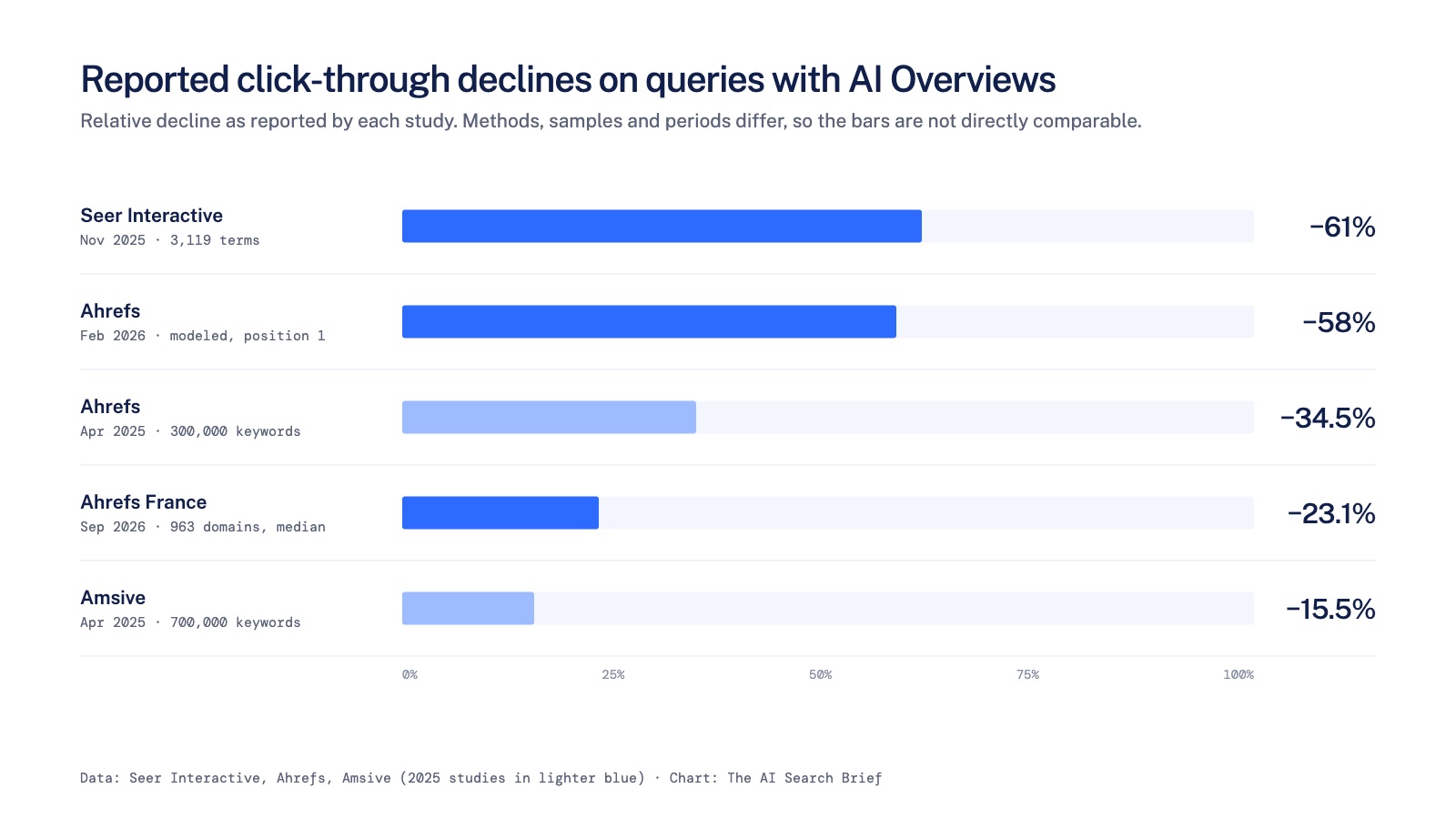
- Ahrefs estimated a 34.5% position-one CTR reduction in April 2025 and a 58% reduction in its February 2026 update, using modeled counterfactuals rather than randomized exposure.[3]
- Amsive found a 15.49% average decline for its AIO-triggering sample, but branded queries rose 18.68% while non-branded queries fell 19.98%.[4]
- Similarweb’s zero-click figures and Google’s aggregate click statement describe broader search behavior, not one universal AIO-specific CTR penalty.[9]
In this brief11 sections
- 01What happened?
- 02Why it matters?
- 03What we know—and what is not confirmed
- 04How large is the click impact?
- 05What do Ahrefs, Seer, and Amsive measure?
- 06What does Similarweb’s zero-click data show?
- 07What does Google say?
- 08Dated timeline
- 09How should marketers measure AIO click impact?
- 10Frequently asked questions
- 11Sources
Google AI Overviews (AIOs) reduce external organic clicks in at least some exposed-query settings, but the public evidence does not support one universal “2026 traffic-loss” percentage. The strongest causal estimate available in this brief is a 39.8% reduction in external organic clicks on searches intended to trigger an AIO, while other studies report smaller, larger, or even temporarily reversing effects depending on the sample and method.[1]
What happened?
The evidence developed across several different measurement approaches between 2025 and November 2026. Pew observed that traditional-result clicks occurred on 8% of visits with an AI summary, compared with 15% of visits without one, while clicks on a cited source appeared on only 1% of summary visits.[2]
A separate 2026 randomized field experiment reported 39.8% fewer external organic clicks when AIOs were shown on queries intended to trigger them, and approximately 18.5% fewer external clicks across all searches in the study.[1] Because the experiment used recruited U.S.-based desktop Chrome participants, its estimate should not be treated as a forecast for every country, device, query, or website.[1]
Large SEO datasets point in the same general direction but produce different magnitudes. Ahrefs estimated a 34.5% relative reduction in position-one click-through rate in its April 2025 analysis and a 58% relative reduction in its February 2026 update.[3] Amsive reported a 15.49% average CTR decline for its AIO-triggering sample, while branded AIO queries recorded an 18.68% increase.[4]
The 2026 evidence is not uniformly negative. Seer reported that AIO-present organic CTR rose from 1.3% in December 2025 to 2.4% in February 2026, although it cautioned that the short rebound was insufficient for forecasting.[5]
Why it matters?
AIOs change the search result page before a user reaches an organic listing. A user may receive a synthesized answer, see citations inside the answer, and stop browsing without visiting a traditional result.[6]
That behavior affects how publishers and brands interpret impressions, CTR, rankings, and referral traffic. A page can remain visible—or even be cited—while receiving fewer conventional organic visits from the same class of queries.[7]
The effect also varies by query type. Amsive found a positive result for branded queries but a 19.98% decline for non-branded AIO queries.[4] Seer found that cited results performed better than uncited results within AIOs, but still underperformed its no-AIO segment.[5]
This makes a single headline percentage misleading. A study measuring position-one CTR is not measuring the same thing as a study measuring all external clicks, total Google traffic, news-publisher traffic, or zero-click searches across the entire Google ecosystem.[1]
What we know—and what is not confirmed
What the evidence supports
- AIO exposure is associated with fewer traditional organic clicks in several observational studies.[8][5]
- A randomized 2026 experiment found fewer external clicks when AIOs were shown on intended AIO-triggering searches.[1]
- Clicking a source cited inside an AI summary is uncommon in Pew’s observed sample: 1% of summary visits clicked a cited source.[2][8]
- Branded and non-branded queries can behave differently.[4]
- Citation visibility may improve performance within the AIO environment, but cited results can still receive fewer clicks than results on searches without an AIO.[5][9]
- The effect is not constant over time: Seer recorded an early-2026 rebound in AIO-present CTR.[5]
What has not been confirmed
- There is no single vendor-wide AIO CTR penalty that applies to every site or query.[9][5]
- The available studies do not establish that every overall traffic decline is caused by AIOs.[3][5]
- Similarweb’s reported zero-click figures are not an AIO-versus-no-AIO CTR experiment.[1]
- Google’s statement that total organic click volume was relatively stable year over year does not provide a numeric AIO-specific CTR estimate.[10]
- The public evidence does not establish one universal percentage for “AI Overviews traffic loss” in 2026.[1][6]
How large is the click impact?
The most direct causal evidence comes from the 2026 field experiment by Saharsh Agarwal and Ananya Sen. Participants were randomized to Google Search conditions with AIOs shown, AIOs hidden, or an exploratory AI Mode condition. The final experimental sample contained 1,065 participants, with 890 remaining at endline after attrition; participants were U.S.-based desktop Chrome users recruited through Prolific and were observed for two weeks.[1]
For searches intended to trigger an AIO, the study reports 0.37 external clicks per search in the AIO condition versus 0.62 when AIOs were hidden. That corresponds to 39.8% fewer external clicks with AIOs shown. Across all searches, the reported reduction was approximately 18.5%.[1]
The result is stronger than a simple before-and-after comparison because exposure was randomized within the study. It is still not a representative estimate of all Google users: the sample was recruited, desktop-only, U.S.-based, and limited to the study period.[8]
Pew’s study measures observed behavior rather than randomized exposure. It tracked browsing activity from 900 U.S. adults during March 2025 and matched 68,879 unique searches with Google result pages scraped in April. Of those searches, 12,593 produced an AI summary.[2]
Traditional-result clicks occurred on 8% of visits with an AI summary and 15% of visits without one. Pew also found that 26% of summary visits ended browsing, compared with 16% of visits without a summary.[8][2] These figures describe a click gap, not a causal estimate, because the result pages were collected after the browsing period and the searches were not assigned randomly to AIO exposure.[1]
What do Ahrefs, Seer, and Amsive measure?
| Study | Sample | Finding | Date |
|---|---|---|---|
| Pew Research Center | 900 U.S. adults; 68,879 unique searches, including 12,593 with AI summaries | Traditional-result clicks occurred on 8% of summary visits versus 15% without summaries; cited-source clicks occurred on 1% of summary visits.[2] | July 2025 |
| Ahrefs | 300,000 keywords divided between AIO and informational non-AIO groups; Google Search Console desktop CTR | Estimated a 34.5% relative reduction in position-one CTR using a counterfactual comparison.[11][1] | April 2025 |
| Amsive | 700,000 keywords across 10 sites and five industries; detailed analysis of 10,000 AIO-triggering keywords | Average CTR declined 15.49%; branded AIO queries rose 18.68%, while non-branded AIO queries fell 19.98%.[4] | April 2025 |
| Seer | 3,119 terms across 42 organizations; 25.1 million organic impressions | Reported a 61% decline in AIO-query organic CTR over its study period.[9] | November 2025 |
| Ahrefs | December 2023 versus December 2025 data using the updated comparison | Estimated a 58% relative reduction in position-one CTR against a modeled no-AIO counterfactual.[3][12] | February 2026 |
| Seer | 53 brands, 5.47 million queries, and 2.43 billion organic impressions | AIO-present CTR rose from 1.3% in December 2025 to 2.4% in February 2026; March values were projections.[5] | April 2026 |
| Ahrefs France | 963 domains; 28 days before and nine days after France’s AIO launch | Median CTR fell 23.1% for highly exposed domains; the control-adjusted estimate was 24.8%.[12] | September 2026 |
| Similarweb | U.S. desktop and mobile web publisher data; separate Google-wide clickstream analysis | News-search zero-click rates rose from 56% to nearly 69% by May 2025; a separate 2026 article reported 68.01% zero-click across Google searches.[7] | 2025–2026 |
Ahrefs’ estimates are modeled relative reductions, not percentage-point declines. Its April 2025 study compared March 2024 with March 2025, while its February 2026 update compared December 2023 with December 2025 and used a non-AIO group to estimate a counterfactual.[3][5]
Amsive’s results show why averages need context. Its overall AIO-triggering sample declined 15.49%, but branded queries increased 18.68% and non-branded queries declined 19.98%.[4] The report did not publish its collection dates, geography, device coverage, raw click counts, formula, or uncertainty estimates.[2][1]
Seer’s results show that the trend can move over time. Its November 2025 report described a substantial decline in AIO-query CTR, while its April 2026 update recorded a rise from December 2025 to February 2026.[5] The rebound does not establish that the underlying impact disappeared, because it covered a short window and the report itself cautioned against using it as a forecast.[5]
What does Similarweb’s zero-click data show?
Similarweb provides useful ecosystem context, but its figures should not be presented as an AIO-specific CTR estimate. Its U.S. publisher report found that the share of news searches ending without a click rose from 56% to nearly 69% by May 2025, while organic traffic to news publishers fell from above 2.3 billion visits at its peak to below 1.7 billion.[7]
The report described an inverse relationship but did not establish that AIOs caused the publisher traffic decline.[1] It also reported that ChatGPT referrals to news publishers grew from just under 1 million during January–May 2024 to more than 25 million in 2025, which measures a separate referral channel rather than Google AIO clicks.[7]
Similarweb’s 2026 article reported a 68.01% zero-click rate across Google searches and said AIOs appeared on more than 20% of queries.[13] Those figures do not provide an AIO-exposed versus unexposed CTR comparison, a complete sample description, or a causal design for AIO-driven click loss.[9]
Semrush supplied counterevidence in December 2025 by reporting that zero-click rates fell from 33.75% to 31.53% for keywords that began triggering AIOs. It also reported higher average zero-click rates for AIO keywords in a cross-sectional comparison, while noting that informational intent may explain part of that difference.[9] This result is observational and does not overturn the randomized evidence.[1]
What does Google say?
In an August 2025 statement, Google said total organic click volume to websites was “relatively stable year-over-year” and that average click quality had increased.[10] Google defined a quality click as one in which the visitor does not quickly return to the search results, treating that behavior as a signal of interest.[6][10]
Google’s statement measures aggregate organic clicks and click quality, not the CTR of a particular query that displays an AIO. It therefore does not directly refute studies finding fewer clicks on AIO-exposed searches.[5]
Google also announced dedicated Search Console reporting for impressions in generative AI features, including AI Overviews and AI Mode, with rollout to websites worldwide reported by August 31, 2026.[3] These reports improve visibility into exposure but do not, by themselves, provide a causal estimate of clicks lost because of AIOs.[1]
Dated timeline
| Date | Development | What it established |
|---|---|---|
| April 2025 | Amsive published a 700,000-keyword analysis.[4] | Average CTR declined 15.49% for its AIO-triggering sample, with different results for branded and non-branded queries.[4] |
| April 2025 | Ahrefs published its first 300,000-keyword comparison.[11] | It estimated a 34.5% relative reduction in position-one CTR using a modeled no-AIO counterfactual.[5] |
| 22 July 2025 | Pew published its observed browsing analysis.[2] | Traditional-result clicks occurred on 8% of summary visits versus 15% without summaries.[2] |
| 6 August 2025 | Google published its aggregate click statement.[10][4] | Google said total organic clicks were relatively stable year over year and click quality had increased.[10] |
| November 2025 | Seer published its first AIO CTR report.[5] | It reported a 61% decline in AIO-query organic CTR over its study period.[9] |
| 4 February 2026 | Ahrefs published its updated comparison.[9] | It estimated a 58% relative reduction in position-one CTR against a modeled counterfactual.[14][3] |
| April 2026 | Seer published its 2026 update.[5] | AIO-present CTR rose from 1.3% in December 2025 to 2.4% in February 2026.[5] |
| 22 July 2026 | France’s AIO rollout supplied a short post-launch comparison window.[12] | Ahrefs later reported a 23.1% median CTR decline among highly exposed domains.[12] |
| 31 August 2026 | Google’s generative-AI Search Console reporting was reported as fully rolled out worldwide.[1] | Site owners gained dedicated exposure reporting, but not a causal click-loss measure.[8][1] |
| 17 November 2026 | Current evidence review | The public research supports an AIO click effect in some settings, but not one universal 2026 percentage.[15] |
How should marketers measure AIO click impact?
A defensible measurement plan should keep exposure, clicks, and query composition separate.
- Compare AIO-present and AIO-absent queries rather than comparing all Google traffic with a single prior period.
- Segment branded and non-branded searches because Amsive reported opposite directional results for those groups.[4][5]
- Separate position, device, country, query intent, and search feature because the major studies use different combinations of these variables.[16]
- Track citations separately from traditional organic clicks because a page can be cited in an AIO without receiving a conventional result click.[5]
- Treat zero-click rates as a broader search-behavior measure, not as a direct AIO CTR metric.[6]
- Report both percentage changes and absolute CTR values so a relative decline is not mistaken for a percentage-point decline.[5]
- Keep the observation window visible and label projections separately from actual data.[5]
The most useful site-level question is therefore not “What percentage of traffic do AIOs remove?” It is “How did clicks, citations, and conversions change for this site’s queries when AIO exposure changed?”
Background: what counts as an AIO click?
An AIO click can refer to different actions depending on the study. Pew distinguished clicks on traditional search results from clicks on a source cited inside an AI summary.[2] The 2026 field experiment measured external clicks and compared randomized AIO-show and AIO-hidden conditions.[1] Vendor studies commonly use Search Console CTR, which relates clicks to impressions and may be limited to particular positions, devices, or keyword cohorts.[5][11]
These outcomes are not interchangeable. A cited-source click, a traditional-result click, an external click per search, and total organic traffic answer different questions. Any reported percentage should therefore identify the outcome, sample, period, and comparison method.
Frequently asked questions
Do AI Overviews reduce organic clicks in 2026?
The available evidence indicates that AIOs reduce external organic clicks in at least some exposed-query settings. A 2026 randomized field experiment reported 39.8% fewer external clicks on searches intended to trigger an AIO and approximately 18.5% fewer across all searches in its study.[1] That result is not a universal forecast for every website or search market.
What did Pew find about AI summary clicks?
Pew found that traditional-result clicks occurred on 8% of visits with an AI summary and 15% of visits without one. Only 1% of summary visits produced a click on a source cited inside the summary.[2] The study was observational, so it measured a click gap rather than proving that the summary caused the difference.[1]
What is the 2026 AI Overviews CTR estimate?
There is no single reliable 2026 CTR estimate. Ahrefs reported a modeled 58% relative reduction in position-one CTR, while Seer recorded AIO-present CTR rising from 1.3% to 2.4% between December 2025 and February 2026.[5] These findings use different samples, periods, and methods.
Do branded searches perform better with AI Overviews?
Amsive reported an 18.68% average CTR increase for branded queries that triggered AIOs, while non-branded AIO queries declined 19.98%.[4] This is a study-specific result, not evidence that branded searches always gain clicks when an AIO appears.
Are zero-click searches the same as AI Overview traffic loss?
No. Zero-click data measures searches that end without a recorded click, while AIO studies compare behavior on searches with and without an AI summary or estimate CTR changes for selected keyword groups.[1] Similarweb’s reported 68.01% Google-wide zero-click rate is therefore not an AIO-specific click-loss estimate.[6]
Sources
- 1The Impact of Google AI Overviews on Publisher Traffic and User Experience: Evidence from a Field Experiment — tse-fr.eu
- 2Do people click on links in Google AI summaries? | Pew Research Center — pewresearch.org
- 3Update: AI Overviews Reduce Clicks by 58% — ahrefs.com
- 4Google AI Overviews: New CTR Study Reveals How to Navigate Negative SERP Impact | Amsive — amsive.com
- 5AIO Impact on Google CTR: 2026 Update — seerinteractive.com
- 6Zero-Click Searches in 2026 | Similarweb — similarweb.com
- 7The Impact of Generative AI: Publishers — rivista.ai
- 8Investigating Click Behaviors On Google Search Result Pages That Produce an AI Overview — arxiv.org
- 9AIO Impact on Google CTR: September 2025 Update — seerinteractive.com
- 10AI in Search: Driving more queries and higher quality clicks — blog.google
- 11AI Overviews Reduce Clicks by 34.5% — ahrefs.com
- 12AI Overviews Cut CTR by 23.1% in France — ahrefs.com
- 13Zero-Click Marketing: What the 2026 Data Means | Similarweb — similarweb.com
- 14Google AI Overview Study - SEO & PPC CTR impact — seerinteractive.com
- 15A search changer: auditing Google’s AI overviews interface in political and news search - ScienceDirect — sciencedirect.com
- 16Methodology | Pew Research Center — pewresearch.org